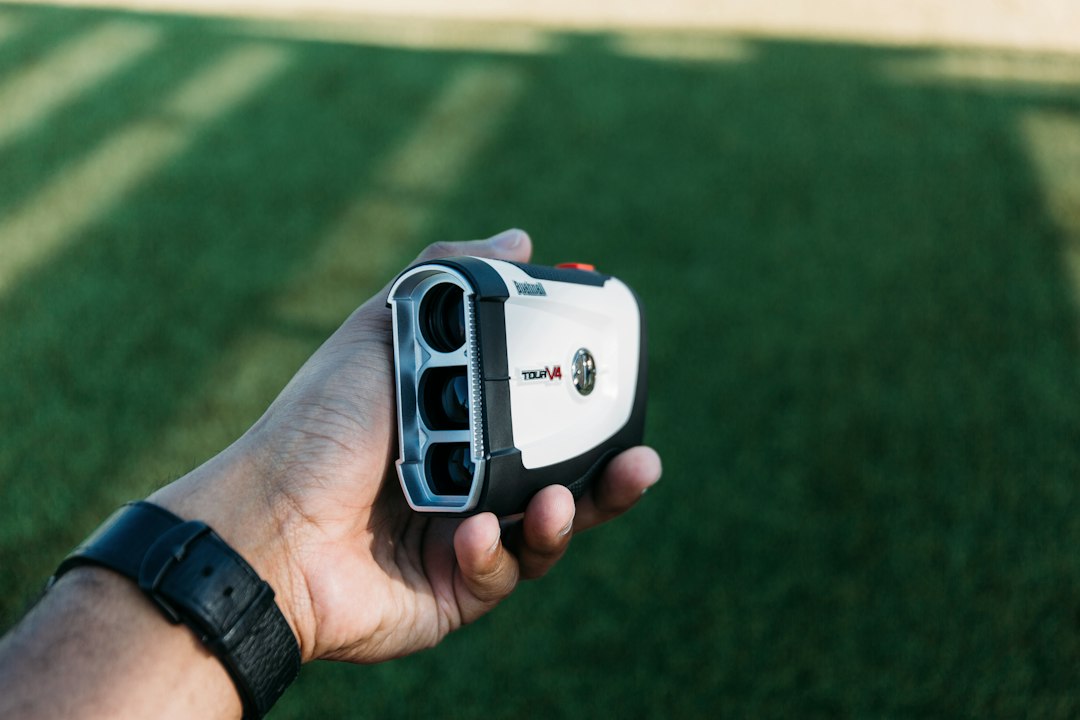
How to Set Up a Bushnell Rangefinder
Setting up a Bushnell rangefinder takes about five minutes, and it comes down to four jobs: fit a fresh battery, twist the eyepiece until the display is sharp for your eyes, learn which button fires the laser, and check that the slope control sits where your round requires it. Do those in order and your first reading will be a true distance rather than a mis-lock. The steps below follow the pattern Bushnell uses across its laser models, with the differences for the GPS handhelds and the Bluetooth models flagged where they matter.
- Fit the battery first, because a tired cell in a Bushnell tends to read short or refuse to lock rather than die cleanly.
- The eyepiece ring is a focus control for your own eyesight, so set it before you judge anything the display tells you.
- Slope has to be switched off for any round played under the Rules of Golf, even where distance measuring devices are permitted.
- Take one reading at a known distance before you tee off, because that is the cheapest way to catch a problem early.
- 🔑 Best golf drivers for beginners covers the other end of the bag if you are still building a set.
- 📚 Golf training aids for home practice is worth a look for the gear that earns its keep between rounds.
What you need before you start
Bushnell sells two families of distance measuring device, and they need different preparation. The lasers take a replaceable battery, while the GPS handhelds such as the Phantom 3 charge over a cable and have no optics to focus. Check your own model's manual before you start, because Bushnell keeps a setup guide and a manual for every current device on its support hub.
Beyond the device itself, a spare 3V CR2 cell, a microfibre cloth for the lens and a clear line of sight to a flag are the whole kit list. If you already keep microfibre cloths for cleaning your balls, the same cloth will do for the front lens, and the guide to cleaning used golf balls explains why you keep one in the bag anyway.
Step 1: fit the battery and check the seal
Most Bushnell laser models run on a single 3V CR2 lithium cell, which sits behind a hinged door on the side or the base of the body. The door only seats one way round, so if it resists, stop and turn the cell over rather than pushing it home.
Before you close the door, run a finger around the rubber gasket and wipe off any grit. That gasket is the water resistance, and a grain of sand trapped in it is how a rangefinder dies a slow death on a wet Saturday. Cold mornings are the other thing to plan for: lithium cells lose punch in low temperatures, so a spare in the bag is worth carrying between November and March.
Step 2: set the diopter for your eyes
The eyepiece ring is the single most misunderstood control on a rangefinder. It focuses the internal display for your eyesight, and it has nothing to do with the distance you are measuring. Turn it until the numbers and the reticle are crisp, and ignore how sharp the view through the device looks.
Do this outdoors in daylight rather than in a dim hallway, because you need enough light to judge the readout. Set it once for your eyes and it stays set, until another player borrows the device and leaves it on their own setting. If the yardage looks blurry but the number is plausible, the diopter is usually the culprit rather than the battery.
Step 3: learn the three controls
A Bushnell laser really only has three things to learn. The power and fire button wakes the device with a single press and takes the measurement when you hold it down. The mode button cycles the display options, which on most models covers the yards and metres switch and the brightness setting. The slope control is either a physical switch on the body or a mode you cycle through, depending on the model.
Then there is the feedback you feel rather than read. Bushnell's JOLT system gives a short vibration when the device has locked onto a target, and learning to trust that buzz is faster than staring at the number and hoping. Digital readouts look convincing whether or not they have measured the right thing, and the vibration is the honest signal.
Step 4: check the slope setting before you play
Since January 2019 the Rules of Golf permit distance measuring devices by default under Rule 4.3a(1), with the important catch that a device may only measure distance. The R&A rule finder spells out that equipment must not measure elevation change, and it must not interpret that information into a club suggestion or a line of play.
In practice that means slope goes off for any round played under the Rules of Golf, and you should also check the local rules or the terms of the competition, because a committee can prohibit devices altogether. On Bushnell's Shift models the slope switch is a physical control you can see and check on the first tee, which makes it the easiest version to police. On other models you cycle through a mode, and it is worth knowing the exact sequence before the round rather than fumbling with it on the fourth.
Step 5: take a reading you can trust
Stand square to the target, brace both elbows against your chest and rest your finger on the fire button. Aim the reticle at the flagstick and hold the button until the device vibrates. Bushnell's PinSeeker technology is there to separate the flag from the trees or the bank behind it, so aim at the pin rather than the general area around the green.
For a lay-up, aim at something with a hard edge, such as a bunker lip, a sprinkler head or a distance marker. Rain, haze and low sun all shorten the range a laser can work over, because the device needs a clean return from the target. If you shoot into a low sun and get an odd number, take a second reading from a step to the side before you trust it.
Step 6: the GPS handhelds set up differently
The Phantom 3 Slope is a GPS unit rather than a laser, so there is no eyepiece to focus and nothing to fire. Bushnell ships it preloaded with more than 38,000 courses, adds a magnetic mount that grips a trolley bar, and shows front, middle and back yardages on a touchscreen. Setup means charging it, switching it on and picking your course, so it suits the golfer who wants numbers without holding a device steady. The slope adjustment is built into the yardages, so it still has to be switched off for competition play.
Step 7: pair a Bluetooth model with the app
Bushnell's LINK models pair with the Bushnell Golf app over Bluetooth, which adds course data and shot tracking to the rangefinder. The pairing itself is a one-off, and a plain Bushnell laser never needs it at all. If pairing will not take, Bushnell's own LINK support page suggests one specific fix first: check your phone's Bluetooth settings, because some phones auto-pair with the device and then block the app from doing the same. Remove it there, toggle Bluetooth off and on, and try again.
When it will not read at all
Always start by checking the battery, even when the device powers up. A weak CR2 produces plausible but wrong numbers far more often than it produces a dead screen, which is why a cheap cell change solves more rangefinder complaints than anything else. Clean the front lens with a dry microfibre cloth next, since a fingerprint or a smear of sun cream on the glass cuts the effective range.
If the numbers look odd but the device behaves normally, reset the diopter and try a bigger target. A bunker, a tree line or a green-side wall will tell you whether the unit is measuring accurately, where a thin flagstick might simply be a hard lock. Past that, heavier rain, mist or low sun are conditions a laser rangefinder cannot argue with, and taking a course guide or a GPS app as a backup on those days is sensible rather than defeatist.
Rangefinders that follow this routine
If you do not own a device yet, the models below all use the setup pattern described above, with a slope control and a battery or a charging port rather than anything exotic. Prices are the Amazon listings at the time of writing and they move around, so treat them as a rough guide.
Bushnell Golf A1-Slope Laser Rangefinder - Bushnell's own compact slope laser, and the closest match to the setup steps in this guide at around £239. If you want the routine in the manual to be the one you just read, the A1-Slope is the obvious starting point.
Bushnell Golf Tour V7 Shift Laser Rangefinder - Bushnell's top Tour model, sold as a Patriot Pack at around £372. The Shift badge means the slope control is a physical switch you can check at a glance, which is the easiest version to police before a medal round: Tour V7 Shift.
Bushnell Golf Phantom 3 Slope GPS - around £150 for a handheld GPS with slope-adjusted yardages, a touchscreen and the magnetic mount for a trolley bar. Nothing to focus and no laser to fire, so it suits anyone who wants front, middle and back numbers without a steady hand: Phantom 3 Slope.
REVASRI Golf Rangefinder - about £32 for slope, pin-lock vibration and an external slope switch you can turn off for competition, which is the cheapest way to find out whether you use a rangefinder often enough to justify one: REVASRI rangefinder.
GLXY 1200Yards Golf Range Finder - around £30, with a slope switch and a vibration alert when it locks. The build is plain at this price and the setup routine is identical, so it makes a sensible second device to leave in a carry bag: GLXY rangefinder.
SUNPOW Golf Range Finder - about £47, and the listing quotes plus or minus one yard of accuracy with 7x magnification, which is the specification that matters when you are hunting a flag beyond 150 yards: SUNPOW rangefinder.
MiLESEEY 1100 Yards Golf Range Finder - around £70, with the listing quoting plus or minus half a yard of accuracy and a 1100 yard range. That is the tightest accuracy claim among the budget models here: MiLESEEY rangefinder.
Kaidrus Golf Range Finder - about £85 for a 1500 yard range and 7x magnification, the longest reach in this list, which helps on long par fives and open links where the flag sits a long way from the tee: Kaidrus rangefinder.
REDTIGER Golf Rangefinder - around £110 for 1200 yards, 7x magnification and a slope switch, in a case that fits a bag pocket rather than a trolley console: REDTIGER rangefinder.
Products mentioned
- Bushnell Golf A1-Slope Laser Rangefinder - slope laser, about £239.
- Bushnell Golf Tour V7 Shift Laser Rangefinder - Patriot Pack, about £372.
- Bushnell Golf Phantom 3 Slope GPS - handheld GPS, about £150.
- REVASRI Golf Rangefinder - slope and pin-lock vibration, about £32.
- GLXY 1200Yards Golf Range Finder - slope switch and vibration, about £30.
- SUNPOW Golf Range Finder - 1200 yards, 7x magnification, about £47.
- MiLESEEY 1100 Yards Golf Range Finder - tight accuracy claim, about £70.
- Kaidrus Golf Range Finder - 1500 yard range, about £85.
- REDTIGER Golf Rangefinder - 1200 yards and 7x magnification, about £110.
Frequently asked questions
How do I switch slope on or off on a Bushnell rangefinder?
On the Shift models it is the physical switch on the body, and you can check it with a glance before you tee off. On other models you cycle through a mode or use an on-screen setting, so check the setup guide for your own model on the Bushnell support site, because the sequence differs between generations.
Is a Bushnell rangefinder legal in competition?
Distance measuring devices have been permitted by default under the Rules of Golf since January 2019, under Rule 4.3a(1). The limit is that they may only measure distance, so slope and any club suggestion have to be off, and your committee's local rules or the terms of competition still decide whether devices are allowed at your club.
What battery does a Bushnell rangefinder use?
Most Bushnell laser rangefinders take a single 3V CR2 lithium cell, while the GPS handhelds such as the Phantom 3 Slope use a rechargeable battery charged over a cable. Your model's manual is the final word, and Bushnell publishes one for every current device.
Why is my rangefinder giving the wrong distance?
Check the battery first, then the diopter, then the lens. A weak cell and a smeared front lens are the two causes that produce odd numbers rather than no numbers at all. Beyond that, rain, haze and low sun shorten the range a laser can work over, so a second reading from a slightly different spot is worth taking.
Do I need the Bushnell Golf app?
Only if your rangefinder is a LINK model, because those are the devices built to pair with it. A standard Bushnell laser works on its own with no phone involved, and the app adds course mapping and shot tracking rather than basic function.
Can you use a rangefinder for a lay-up rather than the flag?
Yes, and it is one of the most useful habits to build. Aim at a bunker lip, a sprinkler head or a distance marker, and hold the button until it locks, which gives you a number for the shot you actually want to play rather than the pin you cannot reach.

Priya covers rangefinders, shoes and training aids for WeekendGolfer, focusing on what helps a weekend golfer rather than tour-level gear.
As an Amazon Associate we earn from qualifying purchases.
Last reviewed: September 28, 2026 · Informational guide · Contains affiliate links